
Emergency®
When It Cannot Wait Until Monday
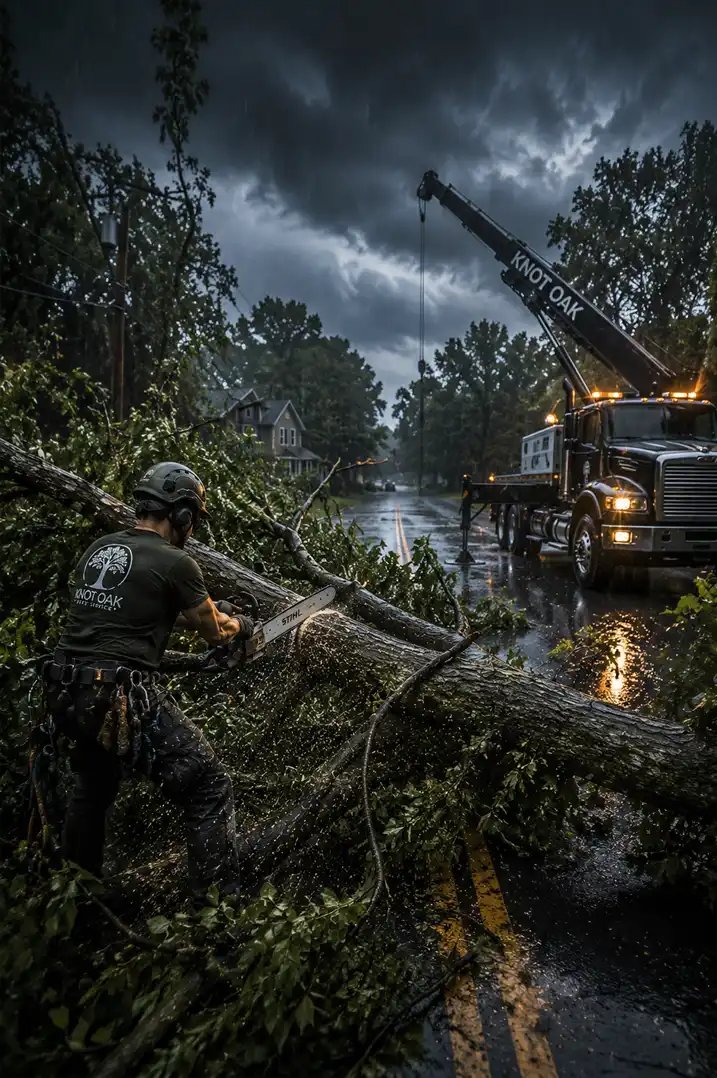
Storms do not keep office hours. A limb through the roof at two in the morning, a trunk split across the drive — those are the calls we take as they come.
Someone answers the phone. We will talk it through, tell you honestly how urgent it is, and get a crew moving if it needs one. If it can safely wait for daylight, we will say that too.
Is This an Emergency?
Most people call because they are not sure, which is exactly the right instinct. If you would rather work it out first, here is roughly how we sort it on the phone.

Call us now
Do not wait for morning
-
A tree or limb is on the house, a car or the drive
Weight on a roof or a vehicle does not settle — it works its way further in. Call before anyone goes back inside underneath it.
-
A limb has broken but is still caught in the canopy
A hanger is the one that catches people out. It is held by nothing but friction, and it comes down on its own schedule — often in the next gust.
-
The trunk has split, or the tree is newly leaning
A lean that appeared after a storm, or soil lifting on the far side of the base, means the root plate has moved. The tree is already failing.
-
Anything is touching a power line
Stay well back, keep everyone away, and call the utility first. We will not touch a tree on a live line until they have made it dead.
-
The tree is blocking your only way out
A drive you cannot get down is an access problem for an ambulance or a fire engine too. That makes it urgent regardless of the tree.
This can wait
Book a scheduled visit instead
-
A few dead branches in the crown
Worth pruning out, and worth doing before the next storm finds them. Not worth a call-out at midnight.
-
A stump left from an old removal
It is not going anywhere. Grinding or extraction is a scheduled job with the right machine on a dry day.
-
A tree you have simply had enough of
Too much shade, too much leaf litter, too close to the washing line. All fair reasons — none of them an emergency.
-
Routine thinning or shaping
Light, airflow and clearance work is better planned than rushed. It is also cheaper booked in than called out.
-
A long-standing lean that has not changed
Trees grow at an angle quite happily. If it has looked like that for years and still does, book an assessment rather than a crew.
When in doubt, call. We would far rather talk you down from a false alarm than hear about it the following week.
What Happens After You Call
An emergency call-out is not the same job as a removal. The aim at night is to take the danger out of the situation and leave the rest for the light.
01 | You call, we answer
A person, not an answering service. Tell us what has come down and what it is resting on — that is the detail everything else hangs off.
02 | We triage by risk
A limb on a bedroom roof goes before a tree across an empty lawn. If wires are in it, the utility goes first and we work behind them.
03 | Crew makes it safe
The night job. Hangers come down, split stems are tied off, weight is taken off the structure and access is cleared. The hazard stops being a hazard.
04 | Full clear-up in daylight
Dismantling a tree properly needs rigging, sightlines and room to work. We come back, take it down the right way and clear the site.
Anyone who promises to finish a storm job in the dark is either lucky or about to make it worse. We would rather be neither.
What to Do Before We Get There
The wait is the dangerous part, because the situation has not settled and standing near it feels reasonable. It is not. Everything on this list is about keeping people away from the tree until we arrive.

-
Do
Keep everyone well clear
Further back than feels necessary — a hanging limb does not fall straight down. Rope the area off if you have anything to rope it with, and keep children and pets indoors.
-
Do not
Do not move or cut anything yourself
Storm-damaged timber is under tension you cannot see. Cut it in the wrong place and it springs — that is how most chainsaw injuries happen, and they happen to people who have used one before.
-
Do not
If wires are involved, call the utility first
Assume every line is live, including the ones lying on the ground and the ones the tree is only leaning against. Stay back and let them isolate it. We work behind them, never ahead.
-
Do
Photograph the damage — if it is safe
Insurers want to see it before it is cleared, and once we have made the site safe that evidence is gone. Take the photos from a distance. No photograph is worth standing under it for.
-
Do
Tell us exactly what has fallen and what it is on
A limb resting on a fence and a limb resting on a roof are different jobs with different kit. The more precisely you describe it, the more likely we arrive with what we need.
-
Do not
Do not go back inside underneath it
If something is resting on the roof, the rooms below it are out of use until we have taken the weight off. Fetching your things can wait. Stay somewhere the tree cannot reach.
Not sure how bad it is? That is a good enough reason to call. Describe it to us and we will tell you what to do next.
+1 (716) 599-8785Proudly serving Buffalo & Western New York
Our certified arborists cover communities across the region, arriving fully equipped and on time. If your town is on the list, we are ready to help with removal, pruning, stump grinding, and emergency care.
- Buffalo
- Amherst
- Williamsville
- Cheektowaga
- Clarence
- Tonawanda
- Orchard Park
- Hamburg
- Lancaster
- West Seneca
- East Aurora
- Depew
Emergency Call-Out Questions
What to do first, how fast we get there, and what happens once the site is safe.
Call Now-
A tree or limb down on a house, car, drive or fence; a hanging limb still caught in the canopy; a trunk newly split or leaning after a storm. If it could fall on someone, treat it as urgent.
-
Keep everyone well clear and do not try to move anything yourself. If wires are involved, stay back and call the utility first — we will work with them.
-
We respond day or night. After a big storm we prioritise by risk, so tell us exactly what has fallen and what it is resting on when you call.
-
The first job is making the site safe — stabilising hangers and clearing access. Full removal and cleanup usually follow in daylight, when it can be done properly.