Tree Trimming®
Cut Well, a Tree Comes Back Stronger
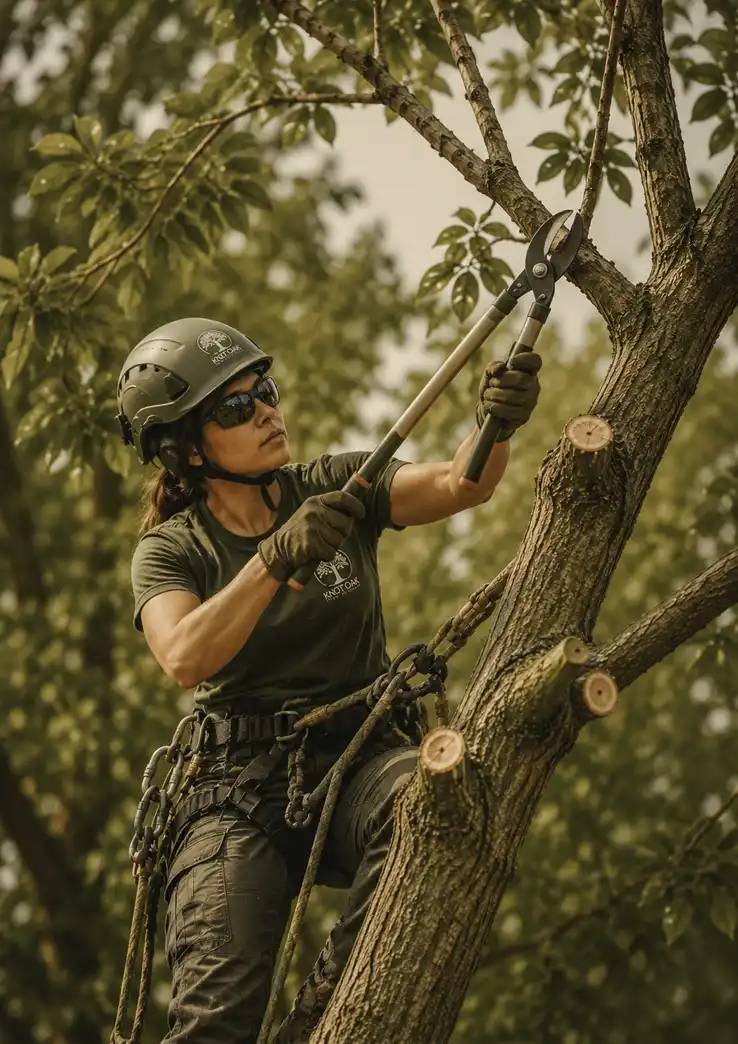
Pruning is the most misunderstood work in arboriculture. It looks like the simple end of the trade — and it is where more trees are quietly ruined than anywhere else.
Good pruning is as much about what we leave as what we cut. Every cut is a wound the tree has to close on its own, so we make as few as the job needs and each one in the right place.
- Cut to the branch collar
- No more than 25% in a season
- We do not top trees
The Four Cuts We Actually Make
"Trimming" covers four quite different jobs, and picking the wrong one is how trees get damaged. In each diagram the dark line is what stays and the brown dashed line is what comes off.
Crown thinning
Selectively removing inner branches to let light and air through the canopy. The tree keeps its outline and its size — from the pavement it looks untouched. What changes is that wind passes through instead of pushing against it.
Outline stays, inner growth thinned
Crown raising
Lifting the lower limbs to give clearance over a path, a drive, a lawn or a roof. We take the bottom tier only and stop there — raise a crown too far and you are left with a lollipop on a stick.
Lower limbs lifted to a clearance line
Crown reduction
Shortening the whole canopy back to sound growth points, where height or spread is a genuine problem. Each leader is cut back to a side branch big enough to take over as the new tip, so the tree keeps a natural shape. This is the correct alternative to topping.
Whole canopy brought in to the solid line
Deadwooding
Taking out the dead, diseased and crossing limbs and nothing else. It is the lightest work we do and often the only work a mature tree needs — the deadwood is already gone, so removing it costs the tree nothing.
Only the dead and crossing limbs come off
When to Prune
The same cut made in February and in October is not the same cut. A tree closes a wound on its own schedule, and the calendar decides how well it manages.
01 | Late winter
The best window for most species. Bare and dormant, so the structure is visible and spring growth goes straight into sealing the cut. If a job can wait, this is what it waits for.
02 | Spring
The sap is up. Maple, birch and walnut bleed heavily from a fresh cut, so we keep the heavy work off these species until later in the year.
03 | Summer
In full leaf the dead wood shows itself. Good for light shaping and for clearing growth off a roof or a drive, once you can see how far the canopy reaches.
04 | Autumn
The worst time for major work. Decay fungi spread spores exactly when wounds are slowest to close, so a big cut sits open through the wet months.
The one exception: dead or hazardous limbs come off whenever you spot them, in any season. A limb hanging over a drive does not care that it is October. The calendar is for planned work — safety work is not planned work.
The Standards We Hold To
A tree cannot heal a cut the way you heal a graze. It can only seal it off and grow around it. Everything below follows from that one fact.
We do not top trees. It is the one cut we will not make, because it ruins a tree's structure for good — where height is a genuine problem we reduce the crown back to sound growth points instead.

-
We cut to the branch collar
The collar is the swollen ring where a branch meets the stem, and it is the only tissue that can close the wound. Cut flush and you take the collar with it, leaving a hole the tree cannot seal. Leave a stub and it dies back and rots inward. We cut just outside the collar, every time — no flush cuts, no stubs.
-
No more than a quarter in one season
Leaves are how a tree feeds itself, so every branch we take is food removed. Go beyond about a quarter of the canopy and the tree panics — it throws out weak, rapid regrowth to replace what it lost, and that growth is poorly attached and breaks. If more needs to come off, it comes off across two seasons.
-
Crown reduction, never topping
Where height or spread is a real problem, we shorten the canopy back to sound growth points that can take over as the new tips. The tree keeps a natural shape and seals its wounds. It takes longer and it costs more than lopping the top off, and the tree is still a tree afterwards. If someone has quoted you to top one, get a second opinion.
Been quoted to top a tree, or not sure what a canopy really needs? Ask us about crown reduction and we will tell you straight.
Ask About Crown ReductionProudly serving Buffalo & Western New York
Our certified arborists cover communities across the region, arriving fully equipped and on time. If your town is on the list, we are ready to help with removal, pruning, stump grinding, and emergency care.
- Buffalo
- Amherst
- Williamsville
- Cheektowaga
- Clarence
- Tonawanda
- Orchard Park
- Hamburg
- Lancaster
- West Seneca
- East Aurora
- Depew
Trimming & Pruning Questions
Timing, technique and how much to take — the questions that matter most for tree health.
Contact Us-
Late winter suits most species: the structure is visible and the tree is dormant, so it recovers fast. Dead or hazardous limbs are the exception — deal with those whenever you spot them.
-
As a rule, no more than a quarter of the canopy in one season. Take more and you stress the tree into weak, rapid regrowth — good pruning is as much about what we leave as what we cut.
-
Yes — clearing structures, driveways and lines is routine work for us. For anything touching a service line, tell us when you call so we can plan it properly.
-
No. Topping ruins a tree's structure and invites decay and weak regrowth. Where height is a genuine problem we reduce the crown properly, cutting back to sound growth points.